Resurface or Replace? How to Make the Right Call for Your Florida Driveway
If you're standing in your driveway staring at a network of cracks and trying to decide whether to resurface it or tear it out completely, you're not alone. It's one of the questions we hear most often from homeowners across Largo, Clearwater, and greater Pinellas County — and it's a genuinely important one, because getting it wrong in either direction costs money. Resurface a driveway that should have been replaced and you'll be back at square one in two or three years. Replace a driveway that could have been resurfaced and you've spent two to three times more than you needed to.
Florida adds a layer of complexity that homeowners in most other states don't deal with. Our combination of relentless UV exposure, heavy rainy seasons, and sandy, loose soil creates conditions that accelerate driveway deterioration faster than the national average. What looks like a surface problem here is often something deeper — and what looks like a structural failure sometimes isn't. You need to know the difference before you commit to either path.
This guide walks through the specific signs that point toward each option, the cost trade-offs, and how to evaluate your driveway the right way — so you can make a confident, informed decision.
1. Understanding What Resurfacing Actually Does (and Doesn't Do)
Resurfacing — sometimes called an overlay — means applying a fresh layer of hot-mix asphalt over your existing driveway. It's not a cosmetic patch. When done correctly, resurfacing adds a structurally sound new surface that can extend your driveway's life by 8 to 15 years. The key phrase there is "when done correctly" — and the key requirement is that your existing sub-base must still be in good condition.
Before any overlay goes down, existing cracks need to be filled and any low spots need to be leveled. A tack coat — a bonding agent — is applied to help the new layer adhere properly to the old surface. Skip any of those steps and the new asphalt won't hold. We've seen plenty of driveway overlays fail within two years because a contractor skipped the prep work to save time.
Resurfacing works best when the damage is primarily at the surface level: oxidation, surface cracking, minor raveling, or an overall dull, gray appearance. It is not appropriate for driveways with widespread structural failure, deep base damage, or heavy alligator cracking across a significant portion of the surface.
2. The Signs That Point Toward Resurfacing
There are specific conditions that make resurfacing the right call. If your driveway meets these criteria, an overlay is almost certainly more cost-effective than replacement — often at 40 to 60 percent of the cost of a full tear-out and repave.
- Surface-level cracking only – Cracks that are hairline or narrow (less than a quarter inch wide) and don't penetrate deep into the base are surface issues. They can be filled and sealed before the overlay is applied.
- Damage covers less than 25–30% of the surface – If the deterioration is relatively localized, resurfacing is still viable. Once damage spreads past 30% of the surface area, the economics start to shift toward replacement.
- Driveway is less than 20 years old – An asphalt driveway under 20 years old with a solid sub-base is a strong candidate for resurfacing. Beyond that age, the foundation itself may be compromised regardless of surface appearance.
- No drainage problems – If water drains off the surface properly and there's no pooling or soft spots, the base is likely intact. Drainage issues are almost always a sign of sub-base problems that an overlay won't fix.
- Oxidation and fading without structural weakness – A driveway that's gray, brittle, and losing surface aggregate but isn't sinking or shifting is oxidized — a Florida climate specialty. This is exactly what resurfacing is designed to address.
3. The Signs That Point Toward Full Replacement
Full driveway replacement — removing the existing asphalt down to the soil, regrading and compacting the sub-base, and installing fresh asphalt — is the right call when the foundation itself has failed. No overlay can fix a bad base. Paving over structural problems just buries them temporarily, and they'll resurface faster than you'd expect.
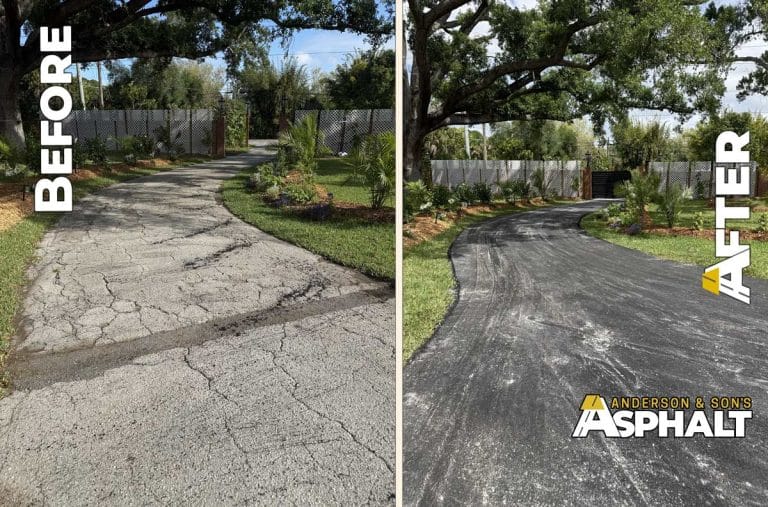
The clearest indicator of base failure is alligator cracking: the interconnected network of cracks that looks like reptile skin. This pattern forms when the sub-base can no longer support the weight of vehicles above it — the surface flexes and fractures. When alligator cracking covers more than 25 to 30 percent of your driveway, resurfacing is throwing good money after bad.
Other replacement indicators include sections that are sinking or heaving, soft spots that compress underfoot or under the weight of a vehicle, deep potholes that have been patched repeatedly and keep returning, and standing water that collects in depressions because the grading has shifted. In Florida's sandy soil, once the base erodes and settles unevenly, there's no way to stabilize it from the top down. Our team saw this firsthand on a 4,500 sq ft driveway replacement in Largo — the surface looked repairable from the street, but the base had shifted significantly underneath, making full tear-out the only viable path.
Age is also a hard factor. Asphalt driveways that are 25 years or older almost always warrant replacement regardless of surface condition. The binder throughout the entire depth of the material has degraded to the point where resurfacing just adds new material on top of something that can no longer hold it.
4. A Side-by-Side Decision Guide
Here's a practical reference that summarizes the key decision points. Use this as a starting framework — and remember that an on-site evaluation is always the most reliable way to determine which path makes sense for your specific driveway.
| What You're Seeing | Likely Call |
|---|---|
| Surface cracks <¼" wide, less than 25% coverage | Resurface |
| Gray, faded, oxidized surface — no soft spots | Resurface |
| Driveway under 20 years old, drains properly | Resurface |
| Alligator cracking covering 25%+ of surface | Replace |
| Sinking sections, soft spots, water pooling in depressions | Replace |
| Potholes that keep returning after patching | Replace |
| Driveway 25+ years old | Replace |
| Damage covers more than 30% of the total surface | Replace |
5. Why Florida's Climate Changes the Calculus
The decision matrix above applies broadly, but Florida homeowners need to weight certain factors more heavily than those in other parts of the country. UV radiation in Pinellas County is intense year-round — more intense than most homeowners realize. Asphalt contains oils that give it flexibility, and those oils evaporate under sustained sun exposure. A driveway here can look and feel old at 12 years if it's never been sealcoated; the same driveway properly maintained can easily hit 20 to 25 years.
Florida's rainy season — June through September — dumps over 50 inches of rain a year across Pinellas County, much of it in intense afternoon storms. Every crack is a water entry point. Once water gets under the surface and into the sandy sub-base soil, it doesn't drain the way it would in denser northern soils. It softens the base, and the surface above it begins to move. This is why what starts as a surface crack in May can be a pothole and a spongy soft spot by October.
The practical implication: in Florida, act on driveway problems earlier than you think you need to. A driveway that's a resurfacing candidate today can cross into replacement territory after a single bad storm season. If you've been watching your driveway and putting off a decision, the cost of waiting tends to be higher here than anywhere else in the country.
6. What Replacement Gives You That Resurfacing Doesn't
Full replacement costs more upfront — typically two to three times the cost of resurfacing — but it comes with advantages that are worth understanding when the situation calls for it. The most significant one is the ability to correct the sub-base entirely. Drainage can be regraded, soil can be properly compacted, and the new driveway starts with a clean foundation that's built correctly for Florida's conditions.
Replacement also gives you the chance to adjust the driveway layout, change the edge treatment, and establish a fresh 20-to-25-year maintenance timeline starting from day one. A new asphalt driveway installed properly in Pinellas County can meaningfully increase curb appeal and property value — something a patched or resurfaced driveway with visible repair history typically can't match when a home goes on the market.
If you're planning to sell your home within the next few years, this calculation matters. Real estate professionals consistently cite driveways as one of the highest-ROI exterior improvements a Florida homeowner can make. A driveway that shows obvious wear or repair history gives buyers a negotiating point; a clean, fresh driveway doesn't.
7. How to Get an Honest Assessment — and What Questions to Ask
The best way to resolve this question for your specific driveway isn't reading a blog post — it's having someone walk it with you and look at the actual condition. What you can do before that appointment is a basic walkthrough of your own. Look for the signs we've described above: crack pattern and width, surface coverage, soft spots, drainage behavior, and overall age. Take photos. That gives a contractor the context to give you a more accurate and faster assessment.
When you're talking to a contractor, a few questions will tell you quickly whether they're being straight with you. Ask them what they see in the sub-base. Ask specifically whether the damage pattern indicates base failure or surface-only deterioration. If they're recommending resurfacing, ask what prep work they'll do before the overlay — crack filling, leveling, and tack coat should all be part of the answer. A contractor who recommends immediate full replacement on a driveway with surface cracking and no soft spots deserves a second opinion. The reverse is also true.
We offer free on-site assessments for asphalt driveway services across Largo, Clearwater, and Pinellas County — no obligation, just an honest look at what your driveway actually needs. If it's a resurfacing job, we'll tell you that. If it needs a full replacement, we'll explain exactly why and show you the evidence. That's how we've built our reputation here, and it's the only way we know how to operate.
Ready to Get Started?
Whether your driveway needs a fresh overlay or a full rebuild from the ground up, getting the right answer starts with a professional set of eyes on the actual surface. The right call saves you money — sometimes thousands of dollars — and gives you a driveway that holds up through Florida's heat, rain, and UV year after year.
Anderson & Sons Asphalt is a licensed and insured, family-owned business with over a decade of experience paving driveways throughout Largo, Clearwater, St. Petersburg, and Pinellas County. We give honest assessments, straight recommendations, and free estimates — no pressure, no upselling.
Get Your Free Estimate →